Handle with care: digital marketing in healthcare
5th November 2026

12th November 2026
Roughly a 9 minute read by
Earlier this week OpenAI launched Businesses in ChatGPT in beta. Brands can now claim a profile, see first-party data on how they're discovered, connect product feeds and, in some markets, build their own conversational agent.
The agents will grab the headlines, but the more useful change for SEO is quieter. For the first time, OpenAI has given businesses a way to manage their information inside ChatGPT and see how often it surfaces them. Most of what it rewards (accurate business information, clean structured data, authoritative content) is work good SEO teams already do.
OpenAI's launch announcement says ChatGPT now reaches 1.2 billion weekly users, although plenty of those conversations have nothing to do with buying. The offering, summarised on the product overview page, has three parts.
| Feature | What it does | Worth knowing |
|---|---|---|
| Business profiles and Business Hub | Verify your business and manage its description, website, categories, logo and policies. Eligible retailers can add product feeds with pricing and availability. | Claiming doesn't guarantee more visibility, and ChatGPT can still draw on other sources. |
| Business Insights | Aggregated reporting on mentions, website clicks and discovery topics | The first first-party AI visibility data from OpenAI itself |
| Business Agents | A branded agent customers can chat to inside ChatGPT, which can be sponsored and used as an ad destination | US ecommerce and online services only for now, with no UK date confirmed |
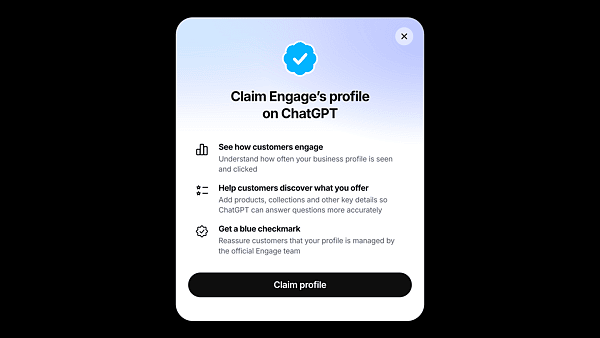
The obvious comparison is Google Business Profile, and it holds up to a point. Both let you verify who you are and keep your details current where customers are looking. But GBP sits on a mature local search product with well-understood ranking factors, while Business Hub is a beta with nothing comparable published. For now, the benefit is more accurate information, and any ranking benefit is unproven. Setup details are in OpenAI's Business Hub documentation.
Until now, measuring AI visibility has meant third-party tools like Semrush and Ahrefs, sampled prompts and referral data. Business Hub adds data recorded by OpenAI itself, across a rolling 28-day window.
| Metric | What it counts | Watch out for |
|---|---|---|
| Mentions | References to your website in ChatGPT, or local location appearances | Naming your brand without linking doesn't count |
| Website clicks | Recorded clicks on links to your site | A click isn't a confirmed visit or conversion |
| Discovery topics | Common themes in answers that mention or cite you | Aggregated themes, not the questions people actually asked |
That first caveat matters more than it looks. In Ahrefs' study of more than 31,000 mentions of its own brand, ChatGPT linked to its website in only 26.9% of appearances. It's one brand rather than a universal rate, but it shows how much visibility a link-only metric can miss.
So we'd treat Business Hub as one source of evidence among three: what OpenAI observes, how brands appear in independent prompt testing against competitors, and what referrals actually do once they land on site. Connecting those signals tells you far more than any one of them.
Not yet. There's no prompt-level reporting, average position, page-level impressions or competitor data. You can't see individual conversations, even with your own agent, and data drops out below reporting thresholds. Barry Schwartz flagged several of these gaps in his early testing for Search Engine Roundtable, while noting how useful it is to see click data straight from ChatGPT.
More than it did, but still far less than Google. These two studies use different methods, so read them side by side rather than combining the numbers.
| Study | What it found |
|---|---|
| Semrush, April 2026: 17 months of US clickstream data | ChatGPT referral traffic up 206% year on year (January 2025 to January 2026), with web search used on 34.5% of sampled queries in February 2026 |
| Ahrefs, February 2026 | Google still sending around 190 times more traffic to websites than ChatGPT |
None of this makes a case for abandoning SEO in favour of AI tactics. People move between platforms: researching a category in ChatGPT, comparing brands on Google, reading reviews, then buying direct. Others do almost everything in ChatGPT and only visit a site when they're ready to buy. Both routes need measuring.
Appearing for one prompt doesn't prove much. Semrush and Kevin Indig's July 2026 research looked at more than 50,000 brands across 1,094 topic categories, and found a clear visibility leader in just 15.2% of them. Traditional domain-level SEO metrics weren't a reliable predictor of who led, either. They still matter, they just don't explain the whole picture.
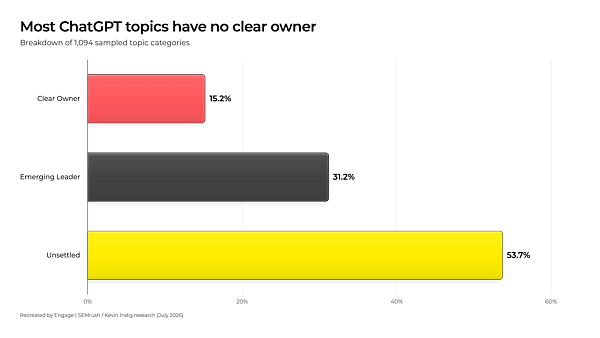
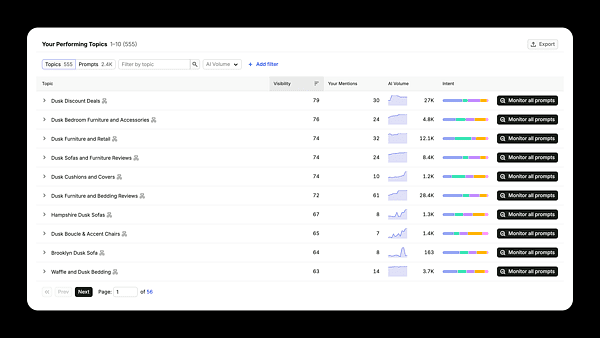
In practice, a retailer might appear for “best products in X” and vanish when someone asks about alternatives, materials or a specific use. Business Hub's discovery topics can show where you already turn up, but not where you're missing. That still takes customer research, competitor analysis and independent testing at topic level.
Business Hub accepts product feeds as CSV files, hosted feeds or supported Shopify catalogue connections, following OpenAI's product feed specifications.
Picture someone asking ChatGPT for a wool jumper in autumnal colours, with a traditional pattern, for under £300. A product page that just says “patterned knitwear” won't help much. Material, colour, pattern, sizing, price and availability will.
Anyone running Google Merchant Center will recognise the checklist:
OpenAI is clear that a feed doesn't guarantee recommendations, and there's no independent evidence yet on which attributes make a difference. We'd treat it as a data quality job and measure what happens.
Business Agents let someone go from spotting a brand in an answer to asking it about sizing, product differences or returns, without leaving ChatGPT. Agent conversations are clearly labelled and kept separate from ChatGPT's own answers, under OpenAI's Business Agents Policy. They can't complete purchases, make bookings or check orders yet.
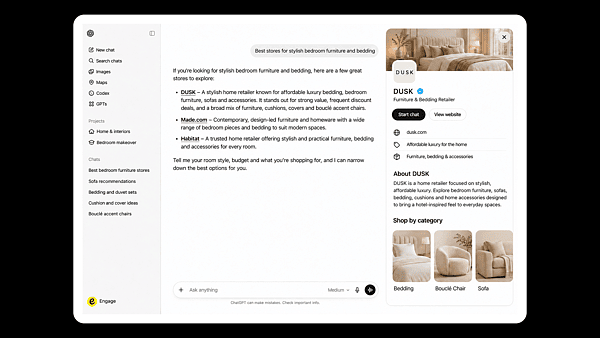
For SEO and conversion, the interesting part is that some of the persuading may start happening somewhere you don't host. Whether customers will want to talk to a brand's own agent, or let their personal assistant do the talking, is anyone's guess for now. Either way, clear and accurate product and service information pays off wherever the conversation happens.
Coverage has centred on first-party measurement, business-controlled information and ChatGPT's growing commercial role. Search Engine Land reported on Business Hub tests before launch, then covered it going live. Search Engine Roundtable walked through claiming and click data, The Verge focused on verified agents, and Reuters framed it as OpenAI moving closer to ecommerce.
Comparisons with the early days of Google My Business are fair up to a point, but it's far too soon for any credible study showing that profile changes lift recommendations or revenue.
There's also a bigger risk than low visibility: being visible and described wrongly. A Search Engine Land analysis from 5th November found AI models often understood a brand's category but got its audience or differentiators wrong. Lots of mentions are worth little if they send the wrong people your way.
| Priority | What we'd do |
|---|---|
| Claim your profile | Where eligible, verify it and manage it like any other key account. Claiming is open to eligible businesses wherever ChatGPT is available, including Europe, so UK online businesses can claim now. Local shops and restaurants can currently only claim existing US listings, per OpenAI's setup guide, and at least one non-US claim went to a waitlist on launch day. |
| Audit how you're described | Check products, audiences and differentiators across your site, reviews and third-party coverage, not just the profile. |
| Treat product data as a discovery asset | Improve feed quality across every platform rather than running a ChatGPT-only project. |
| Add Business Hub to reporting | Combine it with topic-level testing, representation reviews and referral analytics, and don't credit every rise to one change. |
| Get ready for conversational selling | Make product differences, policies and suitability easy to understand, on your site and off it. |
This is the first time OpenAI has brought business information, first-party insight, structured product data and branded conversations together in one place. It's a real step, but it's early, and we'd resist turning a beta into a list of unproven ranking tactics.
The immediate gains are better information, more transparency and stronger measurement. Good SEO is still aiming at the same thing. Businesses in ChatGPT just adds another place where that work has to show results.
5th November 2026
19th October 2026

14th October 2026
6th October 2026