Healthcare marketing asks for a gentler touch than most sectors. People search when they’re worried, short of time or choosing on behalf of someone they love. B2B buyers in healthcare, from clinicians to IT leads, expect evidence before they’ll take a supplier seriously. Regulation limits what you can say, and the ad platforms add their own rules on top.
Healthcare marketing problems tend to get a familiar diagnosis: not enough visibility. The prescription is usually more spend. But a worried family or a sceptical buyer needs a reason to believe you, not just see you, and they need it quickly. Which is why performance tends to improve when marketing is built around how healthcare decisions are actually made.
At Engage, we have vast experience in the healthcare sector, from software providers to care groups. This guide shares what that experience has taught us, and what you should look for in a healthcare marketing agency.
What drives performance in healthcare
Four things set healthcare apart from most sectors, and each one changes how you should market.
The stakes are personal. Choosing a care home or a clinical system is a slow decision. People ask more questions and trust gradually. Content has to answer the worry behind the search, and the keyword is only the starting point.
The rules are tighter. UK advertising rules limit how treatments and medicines can be promoted, health information is special category data under UK GDPR, and ad platforms restrict health-related targeting and claims. Compliance shapes the creative, the channel mix and the tracking from the start.
Credibility is the product. Search engines and people alike hold health content to a higher standard. Named experts and plain language earn more trust than clever copy. An overclaim in healthcare damages trust that took years to build.
Decisions are shared. A software purchase might involve a clinician, a practice manager, an IT lead and finance. A care home enquiry might involve three family members and a hospital discharge team.
That's why generic strategies struggle in healthcare. Trust is earned slowly, and you can't buy your way past that.
media-single-image
rich-text
Seen in practice: setting the digital standard for Lovett Care
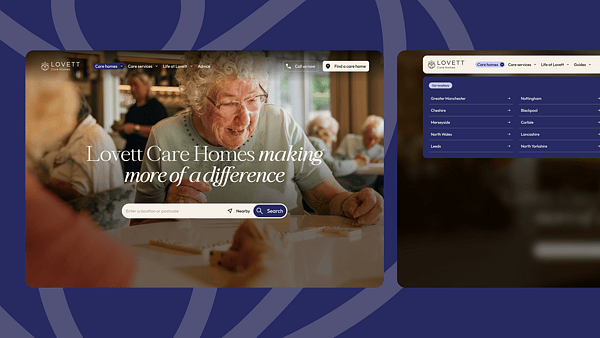
Our work with Lovett Care shows how many of these pressures land on one website. After acquiring New Care, the group had grown to 28 homes and more than 1,800 beds, and our brand transformation had unified it under one name and one visual system. The next job was a website to match.
Two domains had to become one without losing the local search visibility that drives enquiries and occupancy. The site also had to serve families planning ahead and families arriving in urgent situations after hospital discharge, and it had to feel warm in a sector where websites often feel clinical.
We built two journeys: direct call routes and streamlined enquiries for urgent cases, and deeper guides, including a reworked Dementia Guide, for those researching. SEO was embedded from day one, with dedicated location pages for searches like “care homes in Manchester”, and a carefully managed migration moved authority across from the legacy domain without disruption. A bespoke CRM integration replaced manual enquiry handling.
The results? A 70% increase in conversion rate, a 90% increase in sessions and a 460% increase in AI mentions.
Four pressures make a one-size-fits-all approach hard to defend.
Regulation shapes the plan. Claims, targeting and data handling are all restricted, so the strongest campaigns are designed around the rules from day one. A campaign that relies on the claim a platform rejects has no plan B.
Trust takes longer to earn. Users need significant reassurance before they pick up the phone or book a demo. Without visible expertise and proof, even high-intent traffic leaves.
Targeting is limited. Major ad platforms restrict health-related audiences, which puts more weight on creative, messaging and landing pages than on clever audience building.
Attribution is messy. Long, shared decisions play out across devices and over weeks, so the channels that build confidence early get undervalued.
How B2B and consumer healthcare marketing differ
Same sector, different jobs. B2B healthcare marketing is a long game. Sales cycles run for months, audiences know their field better than you do, and evidence and product depth beat slogans. A B2B healthcare marketing agency needs to be comfortable with that complexity.
Provider and consumer marketing (care homes, clinics, private practices) has shorter cycles but heavier emotion. Reassurance and local relevance count for more than feature lists. Families want to see what daily life looks like and who they'll be speaking to.
Both rest on the same foundations: a clear point of view, a website that makes the next step obvious, and content that earns its place.
media-single-image
rich-text
Seen in practice: a digital health check for EMIS Health
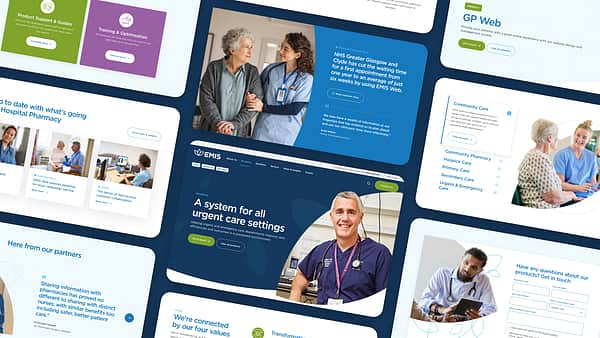
Our work with EMIS Health puts the B2B points above into practice. EMIS serves audiences ranging from primary care IT technicians to pharmaceutical researchers, and each group has its own use cases and its own journey on the website. The old Umbraco site was expensive to run, and both customers and the internal team found it clunky and frustrating.
We rebuilt the site on Craft CMS, with personalised journeys by audience sector, integration with bespoke APIs and third-party tools, and lower licence and development costs than Umbraco. Technical and non-technical colleagues can now manage content themselves, without external support. Full-width sliders and video and photo takeovers no longer need development time to update, and the custom-built animation effects can be switched on and off in the CMS.
Website enquiries are up 223%, conversion rate is up 193% and email marketing opt-ins are up 1,401%.
One of the most common constraints in healthcare sits after the click, once the traffic has already arrived.
Two friction points come up repeatedly.
The credibility gap: a user lands but can't quickly find the signals that confirm you can help, so they try someone else.
The comparison gap: people rarely choose the first option they find. If you're not visible when they come back via remarketing, branded search or organic presence, a competitor is.
Friction on the page compounds both. Long forms, unclear calls to action and limited contact options lose people who are ready to act. Someone choosing a care home often wants a conversation, and a brochure download won't give them one.
When enquiries dry up, the instinct is to blame visibility and buy more traffic. Often the traffic is fine and the page isn't doing its job. Tightening these areas usually moves enquiries faster than adding traffic ever would.
Do digital ads work in healthcare marketing?
Yes, with caveats. Paid search reaches someone with a need right now, and paid social can build awareness and nurture longer decisions. The difficulty sits with the constraints, and the channels themselves are sound.
What works is the same as anywhere, applied with more care: intent-led campaign structures, landing pages that match the query, honest creative, and measurement that goes beyond the click to enquiries, bookings and demos. Strong healthcare landing pages echo what the user searched for and put trust signals above the fold. After that, they make getting in touch easy.
Paid media is an amplifier. It makes a good landing page perform better and a weak one fail faster.
The core drivers of healthcare performance
Across the organisations we work with, performance comes down to four things working in sequence.
Visibility: being present where high-intent demand exists, through expert-led content, strong technical SEO, local search and carefully structured paid campaigns. Our work on the Dementia Guide for Lovett Care is a good example of content reworked around what families were really asking.
Trust: giving users a reason to believe you. Named expertise, reviews, accreditations, clear sourcing and a brand with real warmth. A healthcare branding agency has an unusual brief in a category full of stock smiles and soft blue gradients, and distinctiveness is valuable because it's rare.
Action: removing friction and guiding people clearly to the next step, whether that's a call, a tour booking, a demo or a download. Small improvements here tend to have a disproportionate impact on overall results.
Follow-through: keeping considered decisions warm. Families planning ahead and B2B buyers in long cycles both need a reason to come back, and CRM and email supply it.
Most organisations we see are strong on visibility and weak on trust. Traffic arrives, nothing convinces it to stay, and a paid budget works harder than it should to make up the difference.
How each channel contributes
Each channel does a different job, and mixing those jobs up is how budget gets wasted.
Healthcare SEO captures high-intent demand over time. A healthcare SEO agency has to think beyond rankings: authorship, accuracy, technical foundations, local visibility and clear structure that AI search platforms can understand and surface.
PPC and paid media reaches people with a need right now. It works best when scaling what already converts, within platform rules on health claims and targeting.
Content marketing builds the depth that earns trust. A healthcare content marketing agency should favour pieces an expert would sign their name to, because ten of those beat a hundred nobody would.
Digital PR builds authority from the outside in, with high-quality backlinks and third-party coverage. The best campaigns are data-led and useful to journalists and readers.
Social media builds familiarity and reassurance early in the journey, and keeps organisations visible while people research and compare.
Websites and digital branding is where trust is won or lost. Every channel sends people to the site, so it carries the whole load, from clear journeys to accessibility.
CRM and email keeps considered decisions warm. For long B2B cycles and families planning ahead, it's where interest becomes action.
When healthcare marketing underperforms, a handoff has usually broken. Paid sends people to a page that doesn't reassure, or content is generic where it needs to be expert-led.
Where to focus first
Start at the biggest leak, whichever channel it sits in.
Traffic arriving but no enquiries? Start with landing pages, trust signals and the enquiry journey.
Paid media not scaling efficiently? Look at the landing experience, campaign structure and what the platform will actually approve.
Visibility weak for the questions people ask? Invest in expert-led content and technical SEO.
Long B2B cycles stalling? Build the evidence, personalised journeys and nurture that help buyers make the internal case.
Strong enquiries but local visibility lagging? Focus on location pages, listings and reviews.
Working out which of these sounds like you is usually the quickest way to find where to begin.
What to look for in a healthcare marketing agency
A strong healthcare partner understands how marketing connects to the way healthcare decisions get made. That means:
a working understanding of the regulatory context, built into strategy from the start
a clear view of who makes the decision and everyone who influences it
SEO and content led by real expertise
experience with both B2B and provider audiences, from health tech to clinics and care homes
measurement tied to enquiries, bookings and revenue
A good healthcare marketing agency will also tell you early if the real constraint sits outside marketing, in the product or the sales process.
Ready to build trust that converts?
We bring SEO, paid media, content, digital PR, websites and branding together into a single connected approach for healthcare organisations. If enquiries have plateaued or trust is the sticking point, we'd be happy to talk through where the gap is.
How is healthcare marketing different from marketing in other industries?
The stakes are higher, the rules are tighter and trust takes longer to build. Decisions are often emotional and involve several people, and claims, targeting and data are all regulated or restricted. That means credibility, accuracy and compliance have to be designed into the strategy from the start.
Do digital ads work in healthcare marketing?
Yes. Paid search and paid social can both deliver, but targeting and copy are restricted, so results depend on strong creative, well-matched landing pages and accurate measurement. Ads work best alongside SEO and content that build the trust ads can't build alone.
Why is SEO important for healthcare organisations?
Most healthcare journeys start with a search. Expert-led content, strong technical foundations and local visibility put you in front of people at the moment they need help, and build the credibility that earns the enquiry.
What does a healthcare digital marketing agency do?
It brings together SEO, paid media, content, branding, digital PR and conversion optimisation into a joined-up strategy, with an understanding of the regulatory limits that apply to healthcare.
Is B2B healthcare marketing different from marketing to patients and families?
Very. B2B means longer sales cycles, expert audiences and a need for evidence and depth. Consumer and provider marketing is faster and more emotional, with more weight on reassurance and local relevance.